|
Important: this page is not about history but a view on a history.
A question: To whom does the compound where the Al-Aqsa Mosque is located belong? So yes, there was a time when there stood something else: two temples, the one King David wasn't allowed to built because of bloodshed he committed when he drove the Jesubites from the hills, therefore built by his son King Solomon. There are various visual interpretations found about how the second temple may have looked like, including a computer generated model, which is NOT the second temple but a proposal for a third temple..
ROMAN ERA Herod expanded the existing Hasmonean platform by extending the walls north, west, and south, creating a large rectangular plaza. The temple building itself was situated within this expanded precinct, generally located south of the current Dome of the Rock and west of the Western Wall. However, Herod's temple was destroyed by the Romans during the Siege of Jerusalem. After the Roman destruction of Herod's Temple in 70 CE, no new Jewish temple was built on the site. Instead, the Roman Empire established a new Roman colony called Aelia Capitolina on the ruins of Jerusalem. Now, if we look at "the Roman Empire established a new Roman colony called Aelia Capitolina on the ruins of Jerusalem," what was that colony? The entrance to the colony was the Damascus Gate. The road leading from there into the colony functioned as the axis, which the Romans called 'cardo.' There where houses on both sides of the road. The temple of Aphrodite was between the houses on the right side of the axis. The Temple of Jupiter Capitolinus was built on the left side of the axis, so where Herod's plaza was. Herod's plaza is the current Al-Aqsa compound. With the destruction of Herod's temple, the construction of the Temple of Jupiter Capitolinus, and the establishment of the Roman colony Aelia Capitolina upon the ruins of Jerusalem, the historical continuity of the entire area as Jewish came to an end. This is something the Israeli hardliners don't want you to know. Because Jerusalem as Jewish ends with the transition to those by the Romans. If the Roman construction built upon the ruins of Jerusalem is described a colony, so are all Israeli illegal constructions in the West Bank today, and is the illegal transfer of Israelis and foreigners, mainly Americans, an illegal transfer of colonists. Because settlers are a people who leave their homeland to build a new life elsewhere without having the desire to take the country where they chose to settle.
MUSLIM ERA Jerusalem was first conquered by Muslims in 637 CE (or 638 CE) under the Rashidun Caliphate, when Caliph Umar ibn al-Khattab accepted the city's surrender from the Byzantine Patriarch Sophronius.
The problem begins with the question who built the Al-Aqsa? Was it built by the Umayyad caliphs Abd al-Malik (r. 685–705) or his son al-Walid I (r. 705–715)? However, a smaller, primitive prayer hall (musalla) was built earlier by the Rashidun Caliph Umar (r. 634–644). The current structure of the Al-Aqsa Mosque was completed in 1065 CE during the Fatimid period under Caliph al-Mustansir. Jerusalem came under Crusader rule on July 15, 1099, following the Siege of Jerusalem which marked the conclusion of the First Crusade. Crusader control lasted until October 2, 1187, when Saladin conquered the city after the Battle of Hattin. The city then came under Ottoman rule in 1516, following the Ottoman conquest of the region and the defeat of the Mamluk ruler Kansu Gavri at the Battle of Marj Dabiq. In 1921, the Ottomans lost their part in the First World War. The Britton Mark Sykes and the Frenchman Francoise Picot partitioned the remains of the Ottoman Empire, which led to the Question of Palestine and Jerusalem. If we look at the period after the Crusaders, Jerusalem was under Muslim rule from 1187 until 1921. That is 737 years. It does not include the transition to the Jordanian Hashemite royal family. The custodianship of Jerusalem’s holy sites, including Al-Aqsa Mosque, was given to Jordan’s Hashemite royal family in 1924 following the abolition of the Ottoman Empire by Mustafa Kemal Atatürk. With the loss of the Sultan, the last Ottoman ruler was not a Caliph, as the nominal protector of Islamic holy places, the Supreme Muslim Council—the highest Muslim body in Mandatory Palestine—appointed Hussein bin Ali (Sharif of Mecca) as the custodian to fill the vacuum. The Hashemites, being direct descendants of the Prophet Muhammad and former rulers of Mecca, were chosen for their religious legitimacy and lineage. This arrangement was institutionalized to ensure the protection, maintenance, and administration of the Muslim and Christian holy sites in Jerusalem, a role that has been administered by consecutive Jordanian kings for nearly a century.
THIRD TEMPLE Israelis hold divided and often contradictory views on Al-Aqsa, ranging from strict religious prohibition to far-right political agendas for Jewish sovereignty. The majority of religious Jews, including the Chief Rabbinate of Israel, consider the site so sacred that entry is forbidden to Jews. This ban, based on the fear of accidentally walking over the exact location of the ancient Holy of Holies, has been in place since the 1967 occupation. Most mainstream Israelis and secular citizens view the site as politically sensitive but generally support maintaining the status quo to avoid regional war and preserve peace treaties with Muslim nations. The proposed design for the Third Temple is based on detailed architectural blueprints and a 1:50 scale maquette prepared by the Temple Institute in Jerusalem. The image on the right shows a computerized impression of the temple. The structure is envisioned as a square building measuring 150 meters by 150 meters, with varying heights, located on the Temple Mount in the present location of the Dome of the Rock While most Israelis do not support demolishing the mosque, the current government's backing of these provocations has led experts to warn that the longstanding status quo governing the site has effectively collapsed. While the Islamic Waqf (supervised by Jordan) officially administers the compound, Israeli police is supposed to control all gates, security, and access.
INTERNATIONAL LAW
Under international law, the Al-Aqsa Mosque compound is governed by a binding Status Quo arrangement that designates it as an exclusively Islamic holy site. This framework, rooted in 19th-century Ottoman decrees and formalized through the Berlin Treaty and subsequent peace agreements, supersedes domestic Israeli law. The arrangement mandates that the Jerusalem Islamic Waqf, under the custodianship of the Hashemite Kingdom of Jordan, retains sole authority over the site’s administration, maintenance, and religious rituals, while Israel, as the occupying power, is limited to providing external security. The Jerusalem Islamic Waqf manages all internal affairs, including excavations and maintenance, a role reaffirmed in the 1994 Israel-Jordan Peace Treaty (Article 9). Non-Muslims may visit during designated hours but are prohibited from praying on the compound; Jewish prayer is not permitted under the Status Quo. International law, including UN Security Council resolutions and the International Court of Justice, recognizes East Jerusalem as occupied territory, rendering any Israeli legislative or judicial measures aimed at altering the site’s status null and void. The Israelis are legally obliged to refrain from changing access regulations, religious practices, or the site’s character, with violations considered breaches of customary international law and the Fourth Geneva Convention. There are numerous reports and even this documentary revealing that Zionists among the Trump administration and Israelis want to strip Jordan from its custodianship.
"ANIMALISTIC" PRIMITIVISM A 2025 academic paper notes that since October 7, 2023, "hardly a day passes" without Israeli violations, including police raids, facilitation of Jewish prayers, and harassment of Waqf staff. The OIC Media Observatory reported 23 Israeli violations against 12 mosques in the West Bank with the onset of Ramadan in 2025, including confiscation of loudspeakers and prevention of itikaf at Al-Aqsa. There is one Israeli provocation at the Al-Aqsa that have led to a war on Gaza. That is the 11-day war in 2022 after Hamas had warned that it would respond if the brutal protest crackdown at the Al-Aqsa compound by the Israeli occupation police does not stop. The Israelis ignored the warning prompting a military wing of Hamas to fire rockets. Israeli hard-liners are known for their exploitation of situations they've even created themselves. Al-Aqsa is no exemption. The number of colonist incursions at the Al-Aqsa compound has increased since February 28, 2026. And they use their "religious holidays" for these incursions. For what? It's about the third temple they want. But, does Judaism require a third temple? No, Judaism does not require the physical construction of a third temple. While the belief in a future temple is in certain Judaic branches, and included in daily prayers, mainstream rabbinic authorities prohibit building it, maintaining that reconstruction is strictly tied to the Messianic Age and divine intervention, not through unilateral human action. The latter is what hard liners like Ben-Gvir and Smotrich are trying to enforce. The Trump administration are seeking to strip Jordan from its custodianship. The Israeli extremists are escalating their incursions. Both are a message of bringing back a historical continuity that no longer exist because it was ended by the Romans. In the context of Al-Aqsa, and the way how developments are taking place, it is regression by aggression and violence by these Israelis. It is showing a behavior that is already known in nature where an animal tries to take the territory of a member of the same species. The difference? An attacked animal can defend its territory, Palestinians are not even allowed to defend their holy place. That is why we view the Israeli behavior "animalistic" primitivism.
|

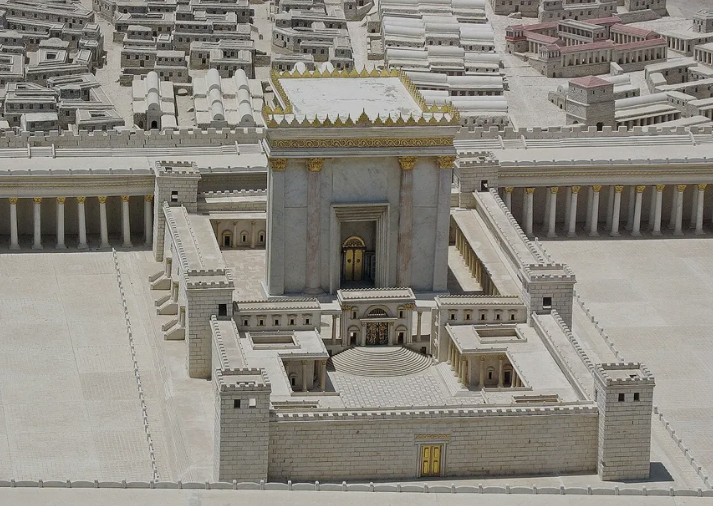 The second temple was the one built by Zerubbabel and was completed around 515 BCE after the Jewish exiles returned from Babylon, authorized by the Persian King Cyrus the Great. The original structure was completed and dedicated in 516 BCE during the reign of the Persian King Darius I.
 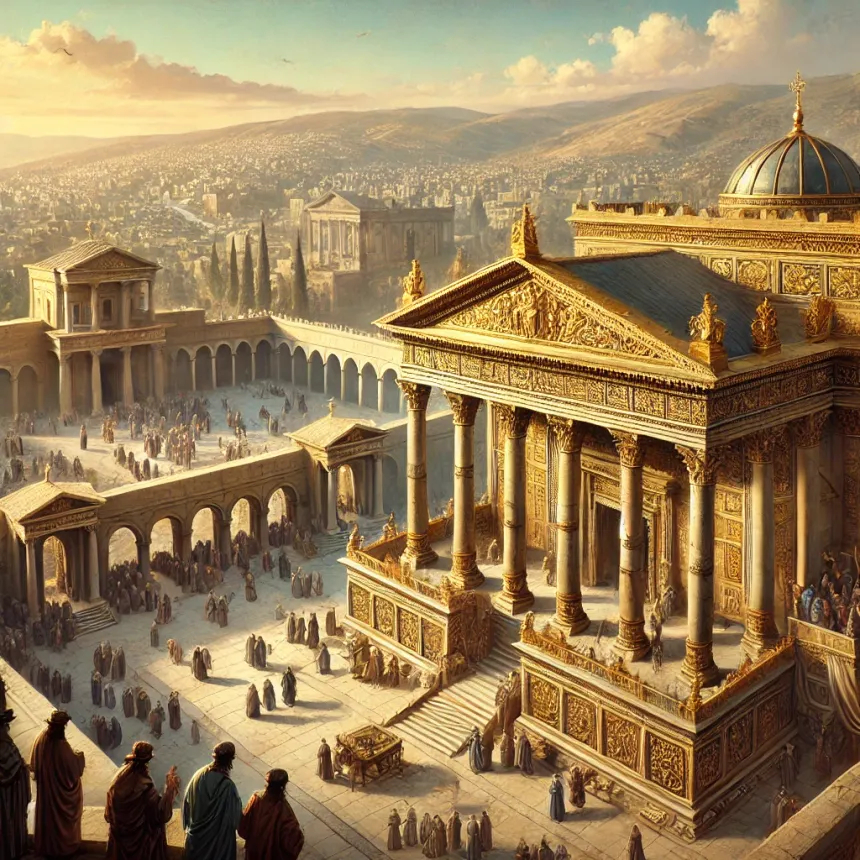 When the Romans appointed Herod as (client) king, he dismantled the Zerubbabel structure completely to rebuild and expand it into the magnificent edifice.
.jpg)
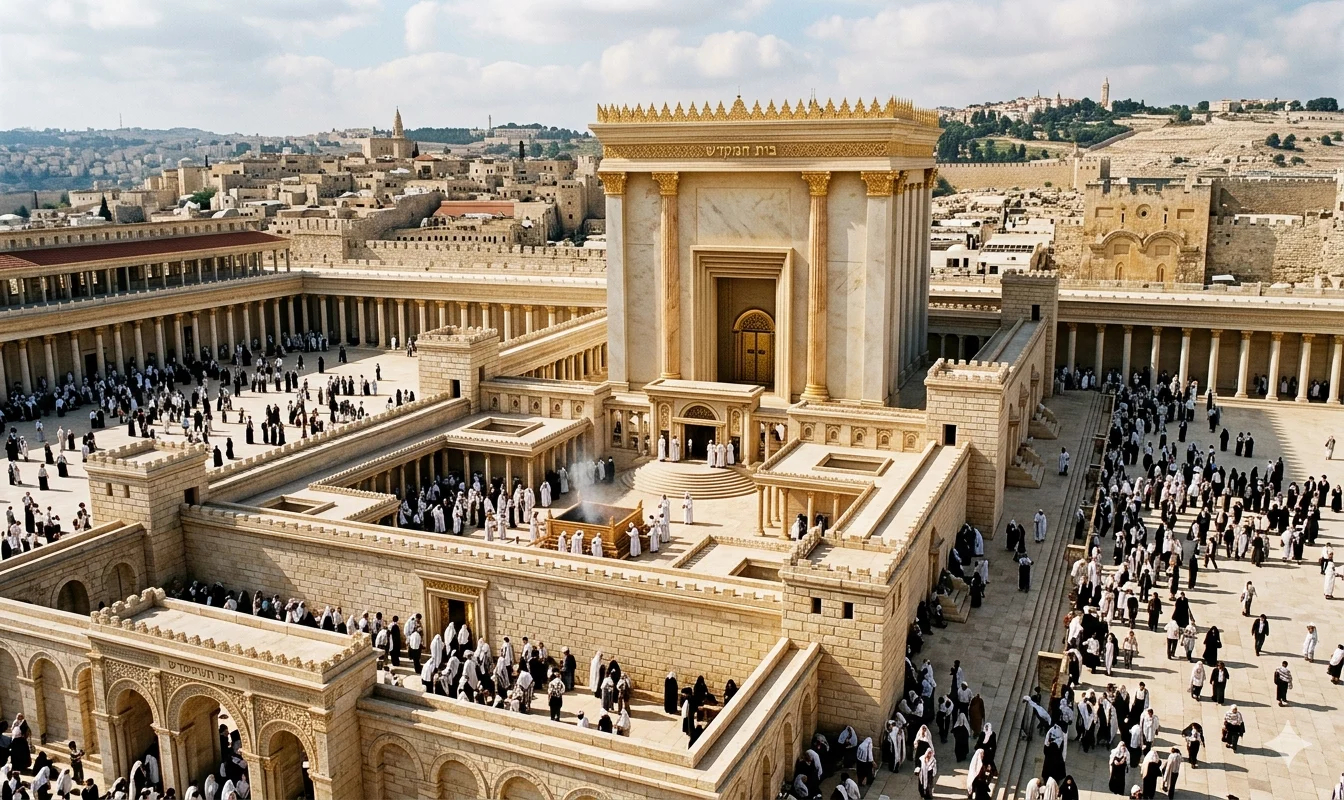 A vocal far-right minority, including politicians like National Security Minister Itamar Ben-Gvir, seeks to impose Jewish sovereignty and allow open Jewish worship, which they argue is a historical right. These groups often push for changes to the status quo, such as building synagogues or erecting temporary structures, viewing the site as the future location of the Third Temple.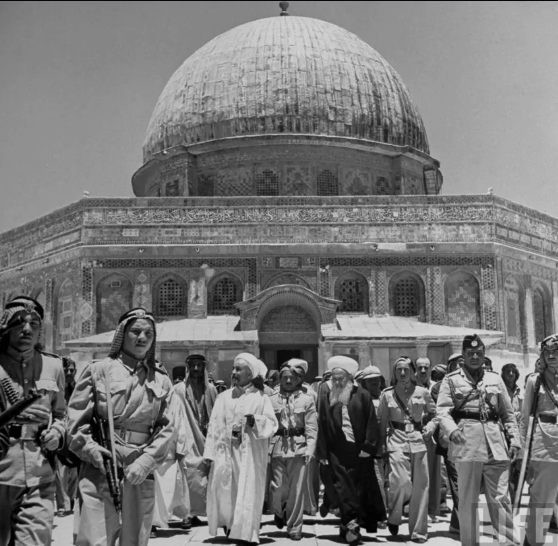
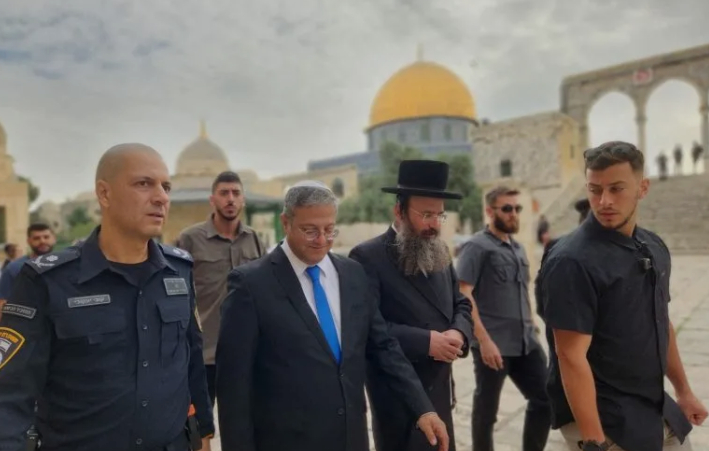 According to the Islamic Waqf, 53,488 Israeli colonists stormed the compound in 2024 alone, an increase of over 18,000% since 2003. In February 2025, there were 9,017 intruders, and the OIC Media Observatory documented eight specific violations just between March 4–10, 2025.